Graffiti Markup Language (GML)
GML is an XML-based file format for archiving graffiti tags. “The new digital standard for tomorrow’s vandals.”
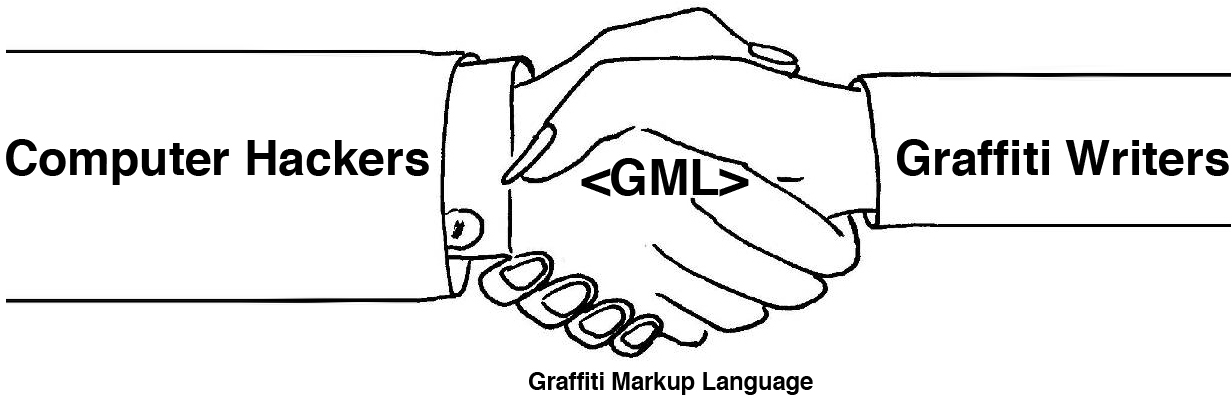 The GML handshake by FAT Lab, 2010.
The idea: capture the motion data of a graffiti tag - the x,y coordinates and timing - so you can replay it, analyze it, or even recreate it with robots. A simple bridge between ink and code.
I was the technical lead on GML, working with project lead Evan Roth, Theo Watson, and Chris Sugrue as part of FAT Lab. The concept started with Evan’s original Graffiti Analysis project back in 2004, but we standardized and opened up the format in summer 2009. The GML core development team also included Golan Levin, and Jérôme Saint-Clair helped write the GML v1.0 spec.
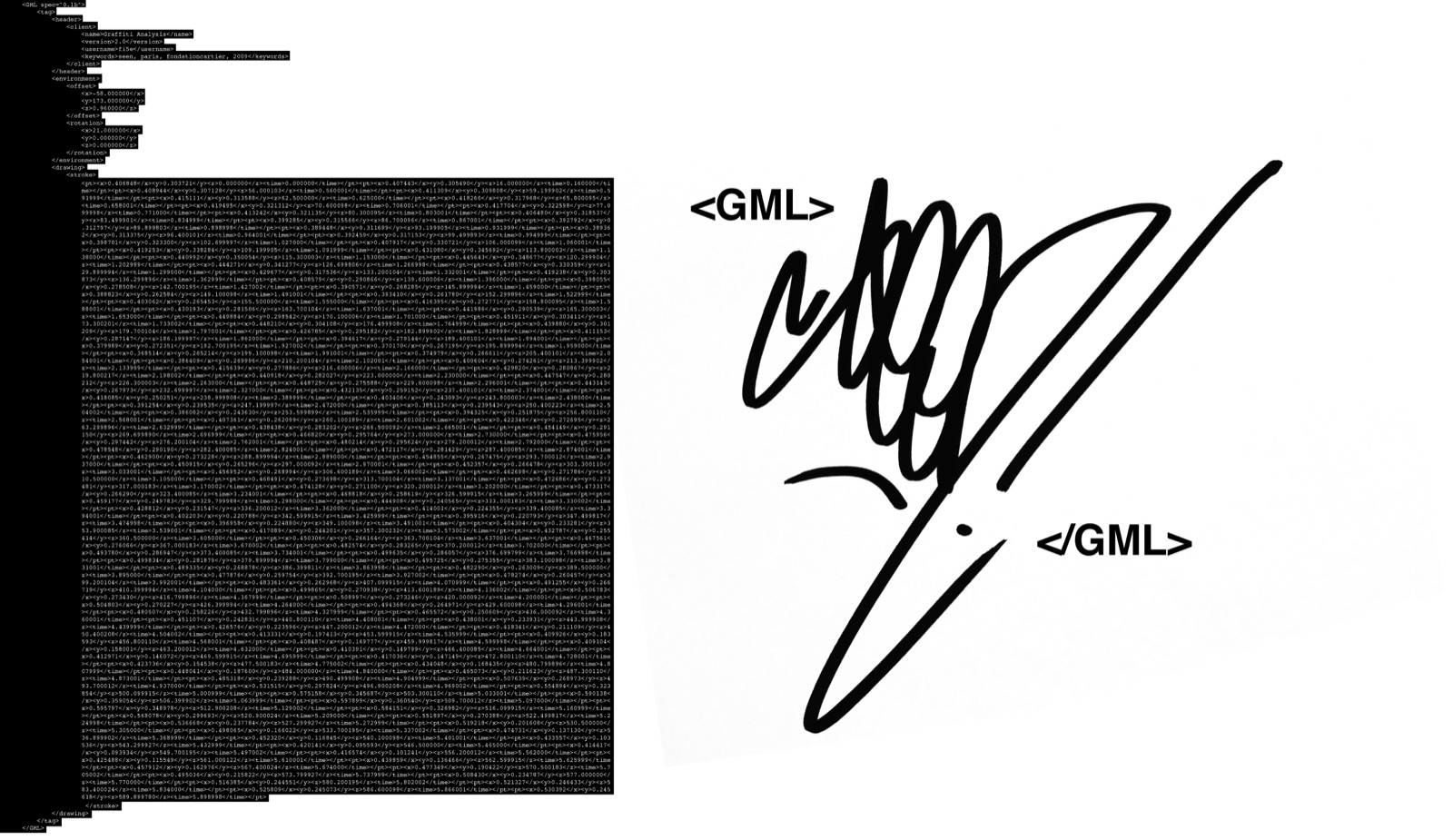 Tag data and the tag it draws. Graphic by FAT Lab, 2010.
We launched it during “GML Week” in January 2010. Some of these tools were new releases, and some were existing projects we updated to read and write GML:
- Graffiti Analysis 2.0 (new) - the app for recording and playing back tags, with new tracking, playback, and graphics
- DustTag (new) - iPhone app to trace your tags and upload them to 000000book
- FatTag Deluxe (Katsu Edition) (updated) - iPhone drawing app made with graffiti legend Katsu
- Laser Tag (existing, now GML-compatible) - project giant tags on buildings with a laser pointer
- EyeWriter (existing, now GML-compatible) - eye-tracking software so paralyzed graffiti artists could still write. Made for Tempt1, it won a Golden Nica at Prix Ars Electronica 2010
- Canvasplayer (new) - play GML tags in a web browser. Rebuilt in 2026, with a 3D mode by Evan
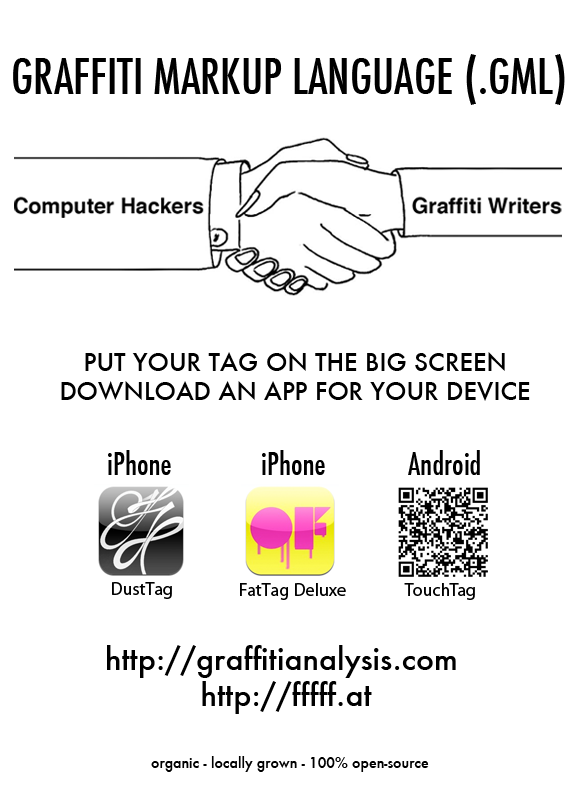 Event flyer by FAT Lab, 2010.
The format was designed to be dead simple - readable by hobbyist programmers, artists, and writers. Since then open source hackers have built plenty of their own. 000000book lists 24 GML apps as of September 2026.
000000book
We also built 000000book (that’s six zeroes, aka “blackbook”) as an open database for storing and sharing GML files. It passed 20,000 tags by August 2010, and it lists more than 76,000 as of September 2026. The idea was to complete the “open graffiti triangle”: open source software (Graffiti Analysis), open data (000000book), and open data formats (GML).
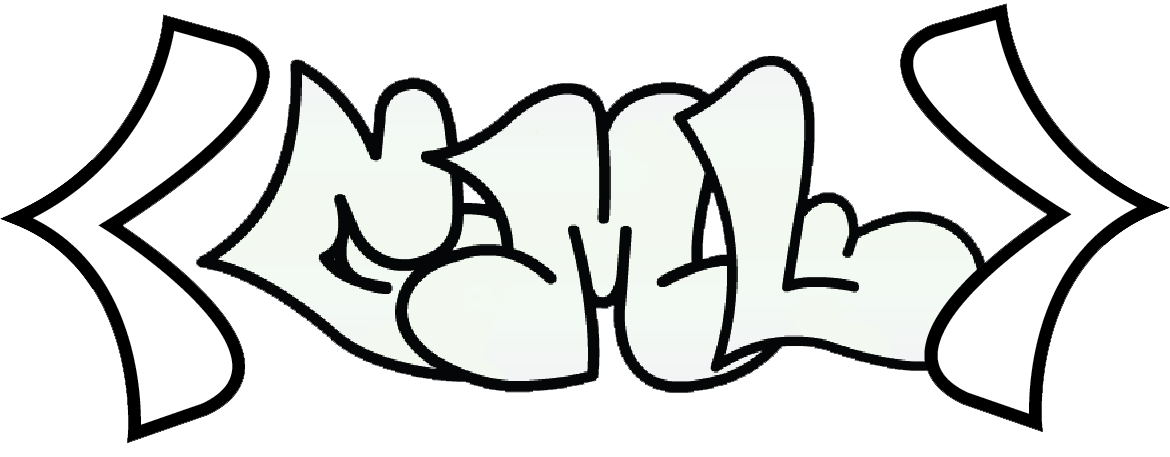 GML throwup by FAT Lab, 2010.
Evan’s talks on GML
Two talks by Evan Roth explain the format better than I can:
- G.M.L. video (2010)
- GML demo and workshop (2010), 11 minutes
Recognition
- Transmediale Open Web Award, 2011. GML was the first winner, an award Mozilla set up with Transmediale in Berlin.
- Tokyo TDC RGB Prize, 2011. The Tokyo Type Directors Club credited it to Evan, Chris, Theo and me.
Press: Rhizome (2010) and Motherboard (2013).
Links
- GML Spec on GitHub
- 000000book - open GML database
- 000000book source code
- FAT Lab GML Week announcement
- Wikipedia: Graffiti Markup Language
- Wayback Machine archive of graffitimarkuplanguage.com
See also: 000000book, Canvasplayer, ScratchML, FAT Lab